
Every story begins as an inkling. ✒️
The Inkling Society is a creative writing workshop for young storytellers ages 10–14 who love creating stories and are ready to strengthen their craft.
For five weeks, writers will explore the entire short-story writing experience—from their initial idea to final revisions. Participants will receive weekly small-group and one-on-one fiction-writing coaching from a licensed PWCS creative writing educator, join a community of fellow writers, and contribute to a class-wide anthology.
Fall Term: Suspense Short Stories
September 23–October 21
Wednesdays | 6:00–7:15 p.m.
Cozy Calico Books
199 Union St, Occoquan, VA 22125
Program Overview
• Five weekly meetings from 6:00-7:15 p.m. Each meeting is 75 minutes. Registration fee includes 5 weeks of instruction, detailed instructor feedback, and a printed copy of the completed anthology.
• Designed for writers ages 10-14 who are at or near a fifth-grade reading and writing level and above. This is an enrichment workshop, not a tutoring program.
• Most drafting will happen between meetings. Class time will focus on community-building, short craft lessons, collaborative planning, and reading and responding to one another's work.
• Sharing aloud is optional, but workshop participation is a core part of the experience.
• The workshop will end with a family open mic and celebration. The completed anthology will be available for pick-up at Cozy Calico Books within 3-4 weeks. You will receive an email when we receive the books in store.
• Note: Program is designed for 10-15 attendees. Activities and structure may be slightly altered depending on final enrollment size.
Workshop Approach
• Students will be explicitly taught how to give feedback that is honest, kind, specific, and useful. The feedback framework is, “Celebrate, Question, Strengthen.”
• All instructor and peer feedback will be given in the spirit of compassion, creativity, and growth. Writers will decide which suggestions support their intentions.
• Planning activities will address character, setting, conflict, point of view, plot structure, drafting, and revision. Conflict will be presented as a broad range of possible internal and external story problems.
Complete Syllabus
Week 1: Introductions, Writing Community, and Story Ideas
Weekly Goal
Writers will begin seeing themselves as members of a writing community and leave with one character, one setting, and one conflict to use as the foundation of a suspense story.
6:00-6:15 - Welcome and warm-up: Quick writing-centered ice-breaker game (TBD)
6:15-6:30 - Introductions and establishing our writing community: Share names, interests, and why we love to write. Create expectations for listening, privacy, respectful disagreement, and giving feedback without taking over another writer's work.
6:30-6:50 - Mini-lesson on suspense: Watch and activity using Victoria Smith's TED-Ed video. Focus on the fear of the unknown, controlling what the reader knows, using setting and imagery, shaping pacing, using dramatic irony, and deciding whether a cliffhanger serves the story. Discuss where we have seen this in popular horror media, and how these elements might serve our stor
6:40-6:45 - Pull from a hat: Each writer pulls one character, one setting, and one conflict. Students may trade once if both writers agree, but unexpected combinations are encouraged.
6:45-7:10 - Story idea round robin: Writers share their three elements. Classmates respond with quick 'What if...?' possibilities, and writers record ideas they may want to develop.
7:10-7:15 - Closure + Weekly writing goal: Writers decide when they will brainstorm and how many ideas they hope to generate before the next meeting. Mutual commitment to bring these to the next meeting to discuss.
Quill Work for Week 2
Bring the character, setting, and conflict pulled during class.
Bring at least five bullet-point or one-paragraph MAX story ideas that use those elements. Writers will be encouraged to use the elements they pulled to challenge their creativity as writers.
Week 2: Plot Diagram and Short-Story Pacing
Weekly Goal
Writers will choose one idea and create a workable plan for a suspenseful short story using a plot diagram, beat sheet, snowflake method, or a combination of these tools.
6:00-6:10 - Warm-up: Star the two ideas with the most energy and turn each into a one-sentence story pitch.
6:10-6:30 - Idea round robin: Share the five ideas in pairs or groups of three (depending on enrollment numbers). Peers ask questions, identify the idea they would most want to read, and writers then choose one idea from their list to add to the class idea bank (this concept is still a WIP, more coming soon)
6:30-6:45 - Mini-lesson on plot and pacing: Review setup, inciting incident, rising action, climax, consequences, and ending. Discuss how these parts can become a paragraph-by-paragraph beat sheet so the setup does not drag and the climax is not rushed.
6:45-7:10 - Collaborative planning workshop: Writers complete a plot diagram, snowflake-method organizer, beat sheet, or combination of the three. Peers and Mrs. Llanos help test whether the conflict escalates and whether each event leads naturally to the next.
7:10-7:15 - Weekly writing goal: Writers identify the planning steps they still need to finish and decide whether they are ready to begin drafting.
Suggested Paragraph-Level Beat Sheet
Hook and setup; disruption; first response; complication; pressure or reveal; climax and choice; consequence and ending. Beats may expand across several paragraphs or be combined, but each should move the central conflict forward.
Quill Work for Week 3
A complete beat sheet, plot diagram, or snowflake-method plan that is ready to discuss with the group.
Writers who feel ready may also begin drafting, but pages are not required yet.
Week 3: Peer Editing and the First Draft
Weekly Goal
Writers will learn how to give useful feedback and apply the process to one another's beat sheets, plot outlines, or early pages.
6:00-6:10 - Warm-up: Rewrite the comments 'It was good' and 'I didn't get it' so that each becomes specific and helpful.
6:10-6:25 - Mini-lesson and teacher model: Mrs. Llanos introduces Celebrate, Question, Strengthen and models the process with an example paragraph. The class discusses the difference between big-picture feedback and proofreading.
6:25-6:45 - Teacher-led peer editing practice: The class works through the example together and practices giving feedback that critiques the writing without criticizing the writer.
6:45-7:10 - Small-group round robin: Writers share a beat sheet, plot outline, or pages if they have begun drafting. Each writer names one concern, and peers respond using the feedback framework.
7:10-7:15 - Weekly writing goal: Writers choose which feedback they will use and break the first draft into manageable writing sessions.
Quill Work for Week 4
A complete first draft. It does not need to be polished, but it should have a beginning, developing conflict, climax, and ending.
Optional anthology title and cover submissions for the Session 4 vote. Titles and covers will be voted on separately, so the winning title and cover do not need to come from the same writer.
Week 4: Endings and Final Revision
Weekly Goal
Writers will decide what type of ending they believe best serves their story and use peer feedback to create a focused, final revision plan.
6:00-6:10 - Warm-up: Write two possible final lines, one that offers closure and one that leaves the reader with an unanswered question.
6:10-6:25 - Mini-lesson on endings: Compare resolved endings, circular endings, reflective endings, twists or reveals, open endings, and cliffhangers. Discuss whether an ending feels intentional and satisfying or whether the story simply stops.
6:25-6:50 - Draft round robin: Writers share a focused excerpt or ask the group to examine a concern in the full draft. Peers respond first to clarity, pacing, suspense, character choices, and the ending.
6:50-7:05 - Anthology vote: Writers vote separately for their favorite anthology title and favorite cover.
7:05-7:15 - Final revision goal: Writers select the two or three revisions that will make the greatest difference and create a plan for completing the final draft.
Between Weeks 4 and 5
Writers may send one draft to Mrs. Llanos by the communicated deadline for personalized feedback.
The writer's bio and presentation slide are due to Mrs. Llanos during this week.
The completed final draft is due at the start of Session 5.
Week 5: Young Authors' Open Mic and Celebration
Weekly Goal
Writers will submit their final work, practice presenting an excerpt, and celebrate one another as contributing authors.
6:00-6:10 - Final submission and warm-up: Submit the final story. Choose a one- to two-minute excerpt and mark pauses, emphasis, and any context the audience needs. Reading aloud remains optional.
6:10-6:20 - Mini-lesson on reading aloud: Practice introducing the story, projecting clearly, slowing down, pausing for effect, and ending confidently.
6:20-6:30 - Writers' round robin: Rehearse excerpts in small groups or encourage classmates who are preparing to read.
6:30-6:55 - Family and friends open mic: Writers who choose to participate read excerpts for classmates, friends, and family. The emphasis is celebration rather than critique.
6:55-7:15 - Closing celebration: Enjoy snacks, recognize each writer's contribution, share the selected anthology title and cover, and explain the printing and mailing timeline.
Final Outcome
Each participant will be included as a contributing author in the finished anthology, provided all required materials have been submitted.
Anthologies will be available for pick-up from Cozy Calico Books three to four weeks after the final meeting. You will receive an email when the book is available to pick up.
There is no additional assignment after Session 5.
The Instructor
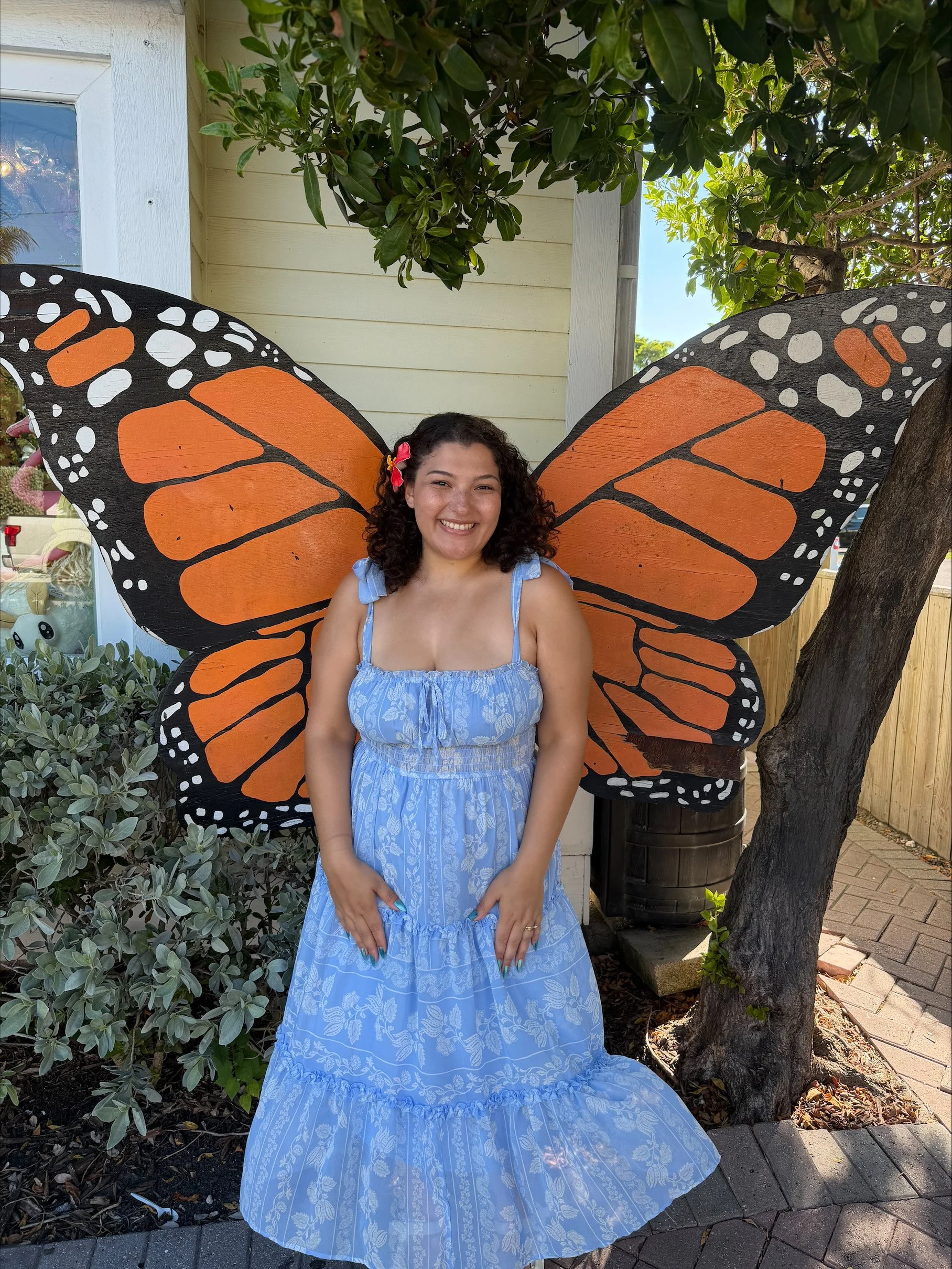
Olivia Shepard Llanos is an educator, writer, and interdisciplinary creator based in Woodbridge, Virginia. In 2023, she earned her BA from the University of Virginia, double majoring in Studio Art and Media Studies. She was a Miller Arts Scholar and graduated with distinction. In 2024, Mrs. Llanos continued her education at the University of Virginia and earned a master’s degree in Media, Culture, and Technology. She now teaches middle school Language Arts in Prince William County Schools. This year will be her third year teaching, and she will teach 6th-grade Language Arts at Parkside Middle School in Manassas, Virginia.
For as long as Mrs. Llanos can remember, she has been drawn to worlds with unique, imaginative worldbuilding, strong-willed and defiant female main characters, and plots that not only make readers swoon, but also encourage them to think critically about society at large. In her teaching praxis, Mrs. Llanos centers the philosopgy that writing is an experimental and vulnerable practice and that young writers can truly cultivate their craft in a safe environment where exploration is not just encouraged but is key to the writing process. Mrs. Llanos aims to create this environment for 6th-, 7th-, and 8th-grade writers through the Inkling Society.
When Mrs. Llanos is not teaching or writing, you can find her drinking inordinate amounts of coffee, spending time with her husband, Gabriel, and her cat, Big Texas, or crafting her next cosplay.
For inquiries, please reach out at sheparoc@pwcs.edu.